

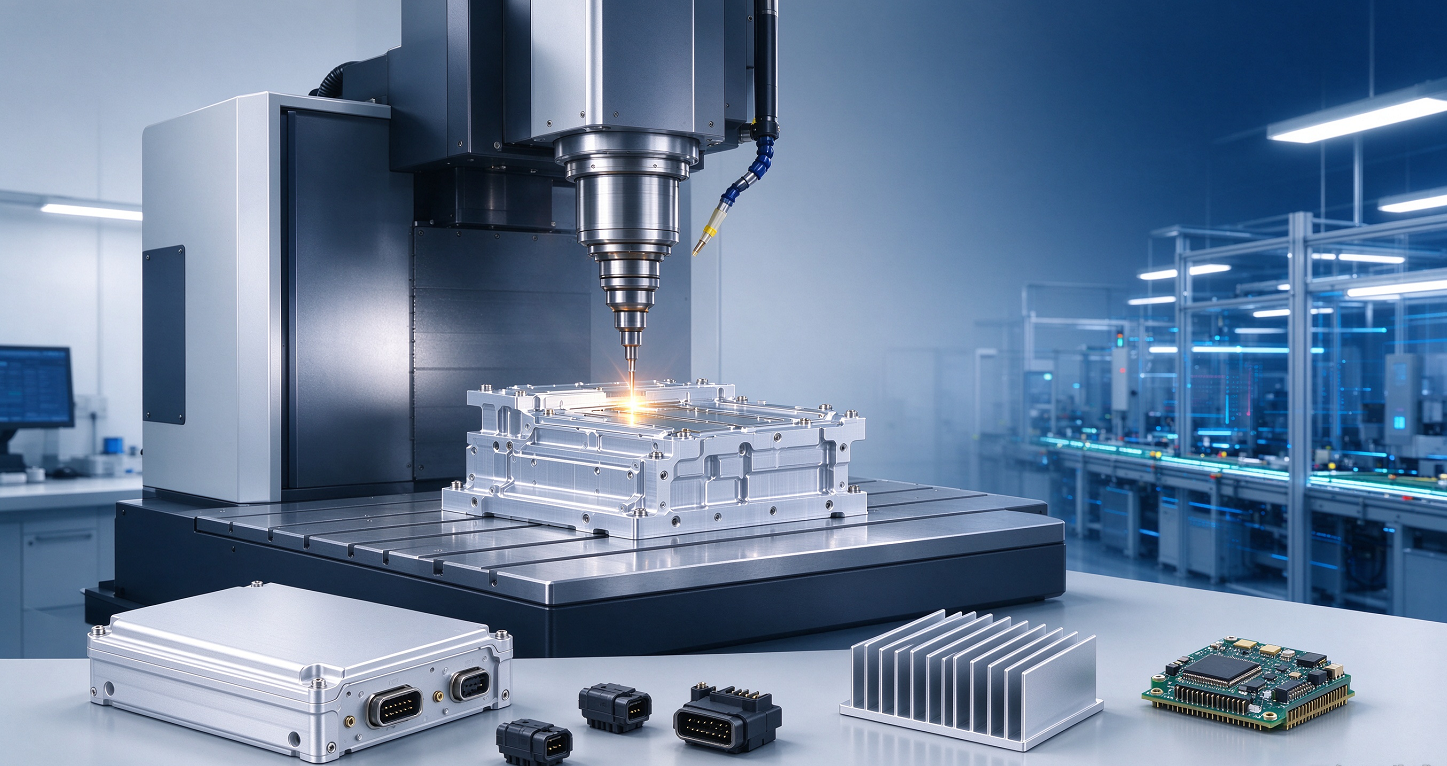
The global electronics industry continues to advance through miniaturization, higher integration, and greater functional complexity. As devices become smaller, faster, and more powerful, the importance of high-precision machined parts has moved from background manufacturing support to a central position in product performance, reliability, and time-to-market.
Machined components are no longer considered simple auxiliary parts. Instead, they serve as fundamental mechanical and functional enablers across consumer electronics, semiconductor manufacturing, communications infrastructure, industrial control systems, and medical electronics. Without consistent precision in these components, even the most advanced chips, sensors, and circuit modules cannot reach their full operational potential.
Precision Machining Meets the Strict Requirements of Modern Electronics
The electronics sector demands exceptionally tight tolerances, stable material properties, and repeatable manufacturing quality. Advanced machining processes such as CNC turning, milling, grinding, and micro-machining are capable of delivering the dimensional accuracy required for highly compact electronic assemblies.
In an environment where circuit boards, chips, sensors, and connectors are densely packed inside slim device housings, even minor deviations can lead to assembly failures, signal interference, thermal issues, or reduced product lifespan. Precision machined parts help prevent these problems by providing consistent structural interfaces, accurate alignment, and stable mechanical support.
Consumer Electronics: Lightweight, Strong, and Design-Friendly
In consumer electronics, machined parts play a visible and functional role in everyday devices such as smartphones, tablets, laptops, wearables, and smart home products. Aluminum alloys, magnesium alloys, stainless steel, and engineered plastics are commonly used to create lightweight yet rigid frames, chassis, brackets, and heat-dissipation structures.
These components do more than protect internal electronics. They also enable slim designs, improved aesthetics, better heat management, and enhanced structural durability. For flagship consumer products, the quality of machined surfaces and assembly fit can directly influence both perceived value and long-term reliability.
Semiconductor and High-End Electronics: Stability at the Micron Level
The role of machined parts becomes even more critical in semiconductor manufacturing and high-end electronic equipment. Production tools, vacuum chambers, positioning fixtures, sensor mounts, and precision stages all depend on machined components with exceptional dimensional stability and material uniformity.
Semiconductor processes often operate in extremely controlled environments, where temperature stability, cleanliness, and mechanical precision are essential. Machined parts used in these systems must maintain their shape, strength, and surface quality under demanding operating conditions, making them a key factor in production yield and equipment uptime.
Communications and Industrial Electronics: Supporting Reliable Operation
In 5G communications, industrial control, automotive electronics, and aerospace-related systems, machined components support a wide range of functional requirements. These include radio frequency cavities, antenna supports, structural frames, connector interfaces, cooling plates, and protective enclosures.
For communication systems, precise machining helps reduce signal loss, minimize electromagnetic interference, and ensure stable performance in challenging environments. In industrial electronics, machined parts contribute to vibration resistance, mechanical durability, and long-term operational stability, which are essential for equipment used in manufacturing plants, infrastructure networks, and field applications.
Material Versatility and Manufacturing Flexibility
Another reason machined parts are indispensable in electronics manufacturing is their material adaptability. Machining processes can handle a broad range of materials used in the industry, including aluminum, copper, stainless steel, titanium, engineering plastics, and ceramics.
Each material is selected based on specific functional needs. Copper, for example, is widely used in thermal management components due to its high thermal conductivity. Stainless steel and titanium offer strength and corrosion resistance for demanding applications. Aluminum alloys provide lightweight rigidity ideal for portable electronics. Machining also supports fast iteration during product development, allowing engineers to modify designs and produce functional prototypes efficiently.
Quality, Reliability, and Long-Term Performance
The electronics industry is under constant pressure to deliver higher performance in smaller form factors. This trend increases the importance of mechanical integrity. High-quality machined components are designed to withstand thermal cycling, mechanical vibration, and long-term use while maintaining structural accuracy.
Poorly manufactured parts can create hidden reliability risks, such as loose connections, stress on circuit boards, misaligned sensors, or overheating. By contrast, precision machined parts provide stable mounting structures, uniform contact surfaces, and consistent mechanical behavior, helping electronics manufacturers improve product quality and reduce field failures.
The Future: Machined Parts in an Intelligent, Connected World
As artificial intelligence, the Internet of Things, high-performance computing, and advanced sensing technologies continue to grow, electronic devices will become even more integrated and complex. This evolution will place higher demands on component precision, thermal management, miniaturization, and structural reliability.
Machining technology is also evolving. Ultra-precision machining, micro-machining, automated production, and digital process monitoring are enabling manufacturers to produce increasingly complex components with tighter tolerances. As a result, machined parts will remain a critical link between advanced electronic design and real-world manufacturing capability.
Conclusion
Machined parts are essential to the electronics industry because they bridge the gap between complex electronic functionality and reliable physical structure. From consumer devices to semiconductor tools, communication infrastructure, and industrial systems, these components support precision assembly, thermal management, signal integrity, and long-term durability.
As the electronics sector continues to innovate, the demand for higher-quality, more precise, and application-specific machined components will only increase. Machining is not just a manufacturing process—it is a strategic capability that enables the performance, reliability, and speed-to-market of modern electronic products.
What to Send for an Engineering Review
Send the current 2D drawing and 3D model, material specification, quantity, critical interfaces, surface finish and requested inspection records. Flag features that must be checked on the first article. A clear review helps identify process questions before the sample is made and creates a more useful basis for quotation. K-TEK provides custom CNC milling, turning and dimensional inspection for industrial components. To discuss a medical or laboratory equipment project, send the component drawings and intended requirements to k-teksales8@ktekpart.com. Capabilities and documentation can be confirmed for the specific part before an order is placed.
Author Information
Writer: Jenny Zheng | Date: Oct 7, 2026 Email: jenny@k-tekmachining.com | Web: www.k-tekmachining.com
Post time: Oct-07-2026


