


Writer: Gabriel Yang
Date: March 17,2026
E-mail: GabrielYang@k-tekmachining.com
Web:www.k-tekmachining.com
Abstract
As global industries continue to demand higher precision and efficiency in manufacturing, CNC machining technology has become one of the most important solutions for modern industrial production. Computer Numerical Control (CNC) machining enables manufacturers to produce highly complex and accurate components with consistent quality, making it an essential process in industries such as aerospace, automotive, medical devices, and industrial equipment.
Keywords: Advanced CNC Technology Accelerates Manufacturing Growth
What Drives Cost for Precision Machined Parts Costs are mainly driven by:
- Machining time (cutting + setups)
- Material cost and yield (raw stock and scrap)
- Part complexity (features, tight tolerances, fixturing)
- Secondary operations (finishes, heat treatment, inspection)
Volume affects per-part price: setup and programming costs are amortized across the run; per-part price falls as quantities increase.

Recently, many manufacturers have increased investment in advanced CNC machining systems to improve production capabilities and maintain competitiveness in the global market. The adoption of multi-axis CNC machines, automated production lines, and digital manufacturing technologies is helping companies significantly improve machining accuracy while reducing production time and operational costs.
One of the major advantages of CNC machining is its ability to produce precision parts with extremely tight tolerances. Traditional machining methods often rely heavily on manual operations, which can lead to inconsistencies and human errors. In contrast, CNC machines operate based on computer-controlled programs that precisely guide the movement of cutting tools along multiple axes. This allows manufacturers to achieve repeatable results and maintain consistent quality across large production batches.
A recent example from the industrial machinery sector demonstrates the growing role of CNC machining in modern manufacturing. A manufacturer specializing in mechanical transmission systems recently completed a project involving the production of precision gear shafts used in heavy-duty equipment. These components required complex geometries, precise threading, and high-strength materials to ensure durability and reliable performance under demanding operating conditions.
Using advanced CNC turning and milling centers, engineers were able to complete the machining process with remarkable efficiency. The production process included rough turning, precision milling, gear cutting, and final surface finishing. Throughout the process, digital measurement systems were used to verify dimensional accuracy and ensure that all components met strict engineering standards.
Another key benefit of modern CNC machining technology is the integration of automated quality control systems. Coordinate Measuring Machines (CMM), laser scanners, and digital inspection tools allow manufacturers to monitor production accuracy in real time. This not only improves product quality but also helps reduce material waste and production errors.
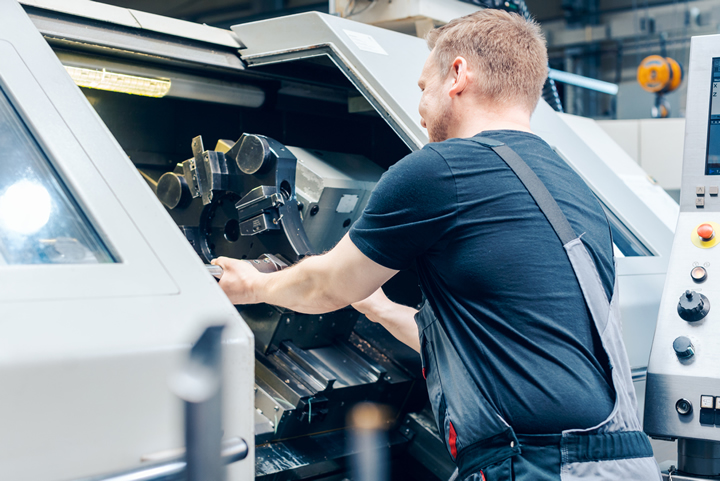
In addition to precision and quality, CNC machining also offers excellent flexibility for custom manufacturing. Engineers can quickly modify machining programs to produce different part designs without requiring significant changes to the equipment. This capability is particularly valuable for industries that require rapid prototyping, small batch production, or highly customized components.
The growing demand for advanced materials such as aluminum alloys, stainless steel, and high-strength alloy steels has also driven further innovation in CNC machining technology. Modern cutting tools and high-speed machining techniques allow manufacturers to process these materials with greater efficiency while maintaining superior surface finishes and structural integrity.
Industry experts believe that the future of CNC machining will be closely connected with smart manufacturing and Industry 4.0 technologies. By integrating data analytics, artificial intelligence, and automated monitoring systems, manufacturers will be able to optimize machining processes and improve overall production efficiency.
As the global manufacturing industry continues to evolve, CNC machining remains a critical foundation for precision engineering. Companies that invest in advanced machining technology and skilled engineering teams are well positioned to meet the increasing demand for high-quality components across multiple industries.
With its unmatched precision, efficiency, and versatility, CNC machining will continue to play a vital role in shaping the future of modern manufacturing.

Post time: Mar-17-2026


